Reimagine and separate for learning. Integrate for living. Cultivate for becoming.
The hub that connects everything — books, curriculum, app, music, and research — in one framework for whole-person learning.
Overview
A Whole-Person Framework for Learning, Becoming, and Human Development
The Meta-Self Learning Model™ is the theoretical foundation of the Meta-Self Learning Initiative™. It views learning as a process of becoming, not only as the acquisition of knowledge or academic skills.
Human development happens across multiple interconnected domains — thinking, emotion, body, culture, motivation, ethics, meaning, and context. Growth in one domain affects the others, and imbalance in one area can influence the whole person.
The model invites learners to ask: What am I learning? Who am I becoming? What do I need to notice, develop, balance, or release?
Here, education becomes formation, not merely information.
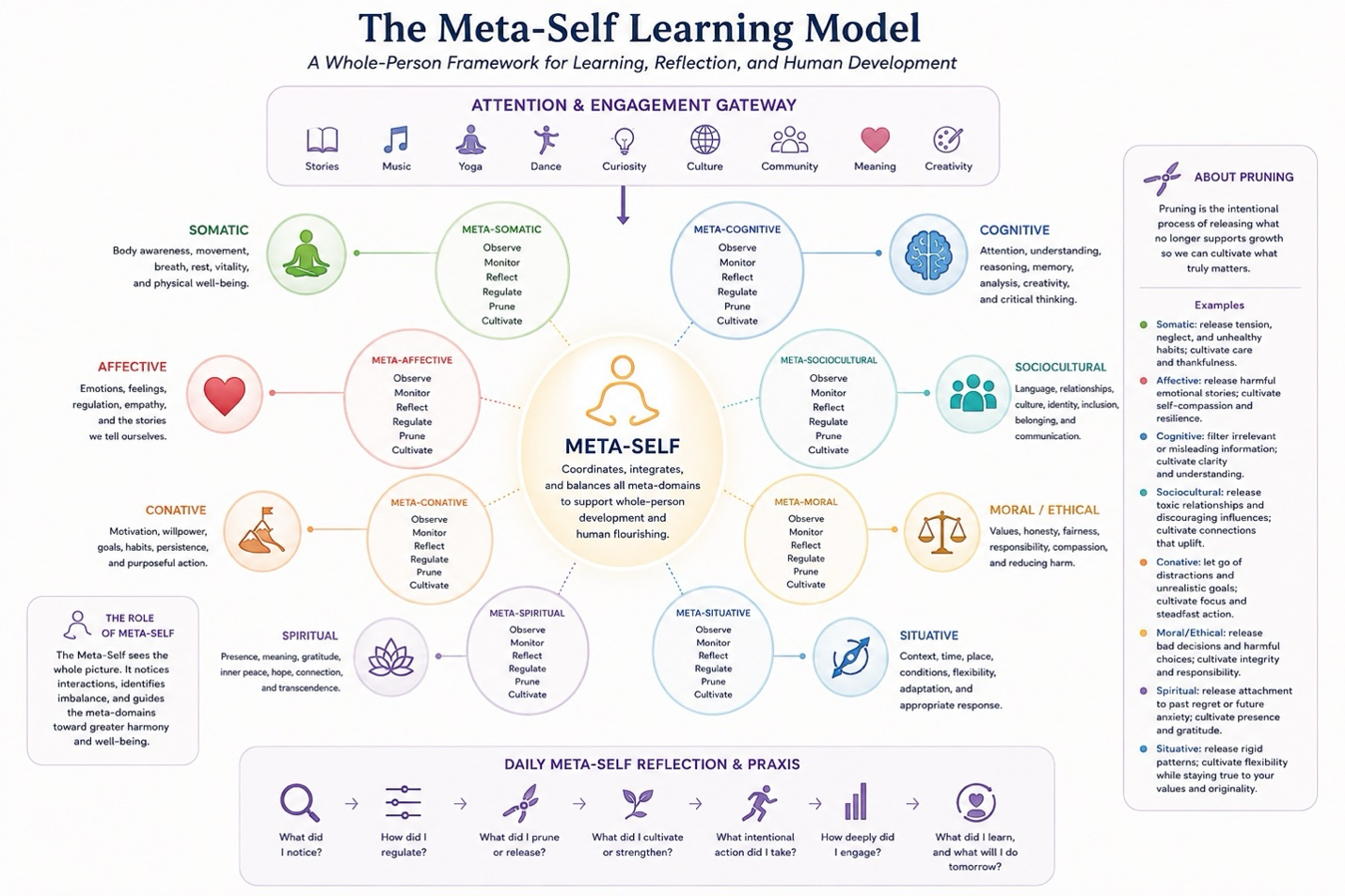
Each domain is observed through its meta-domain, and every meta-domain reports to the Meta-Self at the center — like satellites returning observations to mission control.
The Whole Model
The Meta-Self Learning Model at a Glance
One picture of the whole framework — the engagement gateway, the eight domains and their meta-domains, the integrating Meta-Self at the center, intentional pruning, and the daily reflection & praxis cycle.
How the Model Works
Four Ideas at the Heart of the Model
Attention
Attention is the beginning of learning. Before meaningful growth can happen, learners must first notice what is happening within themselves and around them — thoughts, emotions, body, motivation, cultural experiences, ethical choices, sense of meaning, and learning environment. Attention helps learners move from automatic reaction to intentional reflection.
Becoming & Unbecoming
Learning is not only about gaining new knowledge — it is about becoming: growing into more reflective, balanced, ethical, creative, and adaptive ways of being. Becoming also includes unbecoming — letting go of fear, shame, limiting beliefs, or old patterns that no longer support growth. In this model, growth is both adding and releasing.
The Meta-Self
The Meta-Self is the integrative center of the model. It helps learners observe, reflect on, and balance different dimensions of development. It does not replace the domains — it interacts with the meta-version of each domain, helping the learner notice patterns, tensions, strengths, and areas for growth.
Stepping Outside the System
Inspired by Douglas Hofstadter's work on recursion and meta-level awareness, the model suggests growth often happens when learners pause and observe the system they are inside — an emotion, a thought pattern, a cultural expectation, a habit. Through meta-awareness, the learner steps back and asks: What pattern am I inside? How is it shaping my becoming?
Where Learning Begins
The Attention & Engagement Gateway
Every learning experience begins with attention and engagement. Before learners can understand, reflect, regulate, or grow, something must invite them into the learning process.
These practices are not decorations added to instruction. They are gateways through which learners become emotionally, physically, socially, intellectually, and personally involved. Attention helps learners notice what is happening; engagement keeps them involved long enough for reflection, regulation, intentional practice, and growth to occur.
The domain is the experience itself. The meta-domain is the learner's awareness of that experience.
A learner may feel anxiety — that belongs to the affective domain. When the learner notices, names, reflects on, and regulates that anxiety, they are using the meta-affective domain. Together, these meta-domains interact with the Meta-Self to support reflection, self-regulation, integration, and becoming.
Each meta-domain lets learners observe, notice, monitor, reflect, regulate, adjust, prune, cultivate, and reassess. Within the model, intentional pruning means recognizing patterns that no longer support growth, reducing their influence, and cultivating more helpful alternatives.
Loosening the influence of a harmful emotional story
Filtering unreliable or distracting information
Questioning stereotypes or inherited assumptions
Letting go of ineffective goals or habits
Loosening attachment to past regret or future anxiety
What pruning is not
Pruning does not mean suppressing emotions, denying reality, erasing memories, or forcing positivity. It means consciously deciding what should be released, retained, revised, or cultivated.
Explore the Model
Touch the Eight Domains
Hover, tap, or use your keyboard on any domain — the connection lights up and the panel tells its story.
The Eight Domains
A Map of the Whole Self
Each domain has a reflective meta-version, and every meta-domain reports to the Meta-Self at the center — the pattern you'll see on each card below.
The Song of the Whole Self
Meta-Self — “All of Me”
Every domain has its own song. This one is all of them at once — the introduction to the Meta-Self, where the whole person sings together.
Learning to do what is ethical, even under pressure. Even when the cognitive domain helps us solve a problem, the moral domain guides us to solve it ethically.
Praxis means thoughtful, intentional action rather than activity without reflection. The daily check-in turns the model into a living practice.
Meta-reflection
Noticing, monitoring, regulating, pruning, and adjusting.
Praxis
Putting one or more domains into meaningful action.
Assessment
Evaluating the depth and effect of awareness, regulation, and practice.
Self-correction
Using reflection to guide the next developmental cycle.
What did I intentionally do today, how deeply did I engage, what did I notice or adjust, what did I release, and what will I cultivate next?
Depth-of-Engagement Scale
Level
Meaning
0 — Not engaged
This domain was not meaningfully present today.
1 — Noticed
I became aware of something in this domain.
2 — Practiced
I took an intentional action related to this domain.
3 — Used thoughtfully
I acted with awareness and purpose.
4 — Reflected & adjusted
I monitored the result and changed, pruned, or improved my response.
Daily Integration Questions
Which domain was strongest today? Which needs more attention?
Which two or more domains influenced one another?
What intentional or observable action am I most proud of?
What did I notice and regulate? What did I prune, release, reduce, or revise?
What did I retain, strengthen, or cultivate — and what will I do next?
The Meta-Self integrates both withinness — understanding and regulating each domain from within — and betweenness — recognizing how the domains interact to shape the whole person. The domains are separated for learning, teaching, and assessment, but they are integrated in human life.
In Focus · The Sociocultural Domain
We Become Through One Another
The sociocultural domain emphasizes that human development does not happen in isolation. We learn through language, relationships, culture, dialogue, shared experience, and participation with others. Our identities are shaped not only by the individual "I," but also by the collective "we."
Reflections on Alan Turing's life, together with experiences throughout Dr. EZ's own journey, have strengthened a belief that collaboration is not optional — it is one of the most important conditions for survival, growth, creativity, and meaningful success. Individual intelligence matters, but human beings advance when they think together, support one another, share knowledge, and build something larger than themselves.
collaborationbelongingshared responsibilityintercultural understandingcollective imaginationintersubjectivityempathydialoguecommunitythe power of "we"
The idea of "one soul in different bodies" expresses the deeper unity behind human diversity. We have different languages, cultures, histories, identities, and experiences — yet we remain interconnected.
Beyond Borders: Shared Humanity is a practical application of this domain. Through stories, language, reflection, and cultural exchange, learners are invited to move beyond separation and see themselves as participants in a shared human world.
We do not become fully human alone. We become through one another.
In Liebig's Barrel, each wooden stave represents one essential dimension of the whole system — and the water can rise only as high as the shortest stave. In the same way, human growth may be limited by the least-developed or most neglected domain.
A learner may have strong cognitive ability but struggle emotionally. Another may be highly motivated but lack cultural belonging. The goal is not to perfect every domain, but to notice imbalance and cultivate greater integration — the Meta-Self helps learners recognize which stave needs attention.
Human growth cannot be reduced to one skill, one test, or one academic outcome. Development depends on the balance and interaction of multiple dimensions of the self.
Liebig's Barrel and the Meta-Self Learning Model™
This visualization illustrates that human development is multidimensional. Just as the capacity of Liebig's Barrel is limited by its shortest stave, growth and flourishing may be limited when one domain of human development is neglected. The goal of the Meta-Self Learning Model™ is not to make every domain equal, but to cultivate awareness, integration, and dynamic balance across the eight domains.
Inspired in part by Yuval Noah Harari's reflections on the challenges facing humanity, this metaphor also reminds us that imbalance extends beyond individuals to societies and the natural world. The environmental challenges we face invite us to cultivate greater awareness, responsibility, collaboration, and shared humanity. Within the Meta-Self Learning Model™, education becomes one pathway toward that cultivation.
Educational adaptation and visualization developed with the valuable ideas and collaboration of Dr. Omid R. Zandvakili, Environmental Scientist.
Applied to:ESL & multilingual learningWhole-person curriculumReflective writingAI journalsEducational assessmentPortfolio assessmentTeacher educationMusic, storytelling, yoga & movementApp-based learningWorkshops & professional development
The Model in Action
One Strategy, Many Domains at Once
Now that the whole model is in view, watch how a single classroom strategy cultivates several domains simultaneously. "Learning to Dance with the Devil" demonstrates the Meta-Self Learning Model in practice — and shows why the model draws on more than Bloom alone.
Cognitive
Critical thinking · WH questions
Moral
Ethical AI use · comparing original writing with AI output
Somatic
Breathing · yoga
Spiritual
Reflection
Sociocultural
Pair work · group discussion
Conative
Persistence · certificates · encouragement
And it engages Maslow as well as Bloom — belonging, trust, and love — because learning is never only cognitive.
Foundational Manuscript
The Meta-Self Learning Model™ — Version 1.0
This manuscript presents the original conceptual framework of the Meta-Self Learning Model™ and serves as the foundation of the Meta-Self Learning Initiative™. It introduces the eight domains, their corresponding meta-domains, the role of education and awareness, and the educational applications that continue to evolve through research and practice.